
When you’re considering buying a BMW 540i, you’re likely drawn to its blend of performance, luxury, and style. But before you make such an investment, it’s crucial to be informed about which model years might not meet your expectations.
You might wonder, “Which BMW 540i years should I avoid? ” The answer can significantly impact your driving experience and your wallet. By knowing the years that have had more reported issues, you can steer clear of potential pitfalls and make a more informed decision.
Stick with us as we explore the details, ensuring you make a choice that’s right for you. Your next ride depends on it.
The Lineage: Understanding the 540i Engines
To identify the years to avoid, we must first categorize the 540i by its core heart—the engine.
- The E34 (1992–1995): Featured the M60 4.0L V8. This was BMW’s first V8 in decades and introduced the “Nikasil” controversy.
- The E39 (1997–2003): The legendary 540i with the M62 (and M62TU) 4.4L V8. This is where most mechanical “horror stories” originate.
- The E60 (2004–2010): Note: In the U.S., the 540i badge was briefly retired in favor of the 545i/550i, though it existed in other markets with the N62 V8.
- The G30 (2017–2023): The modern 540i powered by the B58 3.0L Turbocharged Inline-6.
BMW 540i: Critical Years to Avoid
1997–1998: The Nikasil Nightmare
The early E39 540i models used a cylinder lining material called Nikasil (Nickel-Silicon-Carbide).
- The Technical Failure: During the late 90s, gasoline in many regions contained high levels of sulfur. This sulfur reacted chemically with the Nikasil, causing the cylinder walls to pit and degrade.
- The Symptom: Loss of compression, extreme oil consumption, and a “rough idle” that could not be fixed without a total engine block replacement.
- The Fix: BMW eventually switched to Alusil linings. If you are buying a 1997 or 1998 model, verify if the engine block was replaced under warranty (look for a specific “Alusil” casting number on the block).
1999–2003: The Timing Chain Guide Crisis
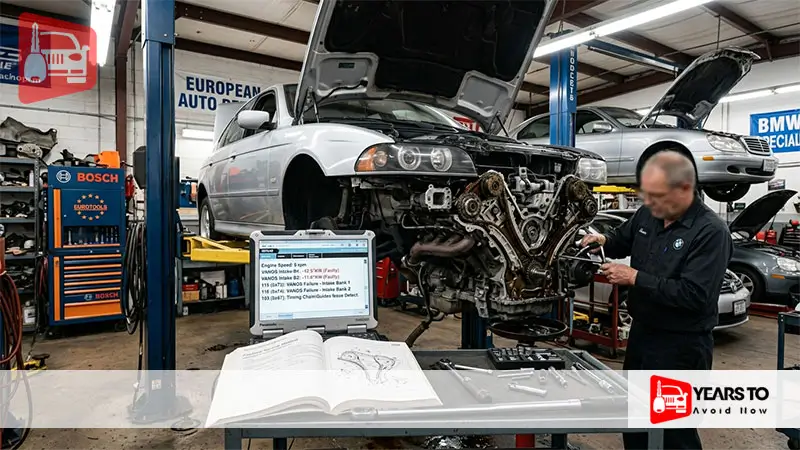
This is the most famous “Critical Technical Pain Point” for the E39 540i. In 1999, BMW updated the engine to the M62TU, adding “Technical Update” features like VANOS (Variable Valve Timing).
- The Failure: The timing chain guides are made of plastic. Over 100,000 miles, the plastic becomes brittle due to heat cycles and acidic oil. Eventually, the guides shatter.
- The “Death Rattle”: Once the guides break, the timing chain slaps against the metal timing cover. If the chain skips a tooth, the pistons will strike the valves, destroying the engine instantly.
- Repair Cost: This is a $3,500 to $5,000 repair because it requires stripping the entire front of the engine.
2017–2018: First-Year G30 “Gremlins”
The modern G30 540i is remarkably reliable thanks to the B58 engine, but the first two production years had minor but frustrating issues.
- Active Grille Shutter Failures: The motorized slats that open and close in the front grille often seize up, leading to “Check Engine” lights and potential overheating during spirited driving.
- Coolant Pump Leaks: A common TSB (Technical Service Bulletin) exists for leaking water pumps and cracked coolant expansion tanks.
Technical Comparison Table: Reliability by Era
| Era / Engine | Years to Avoid | Reliability Rating | Primary Fault |
| E34 (M60 V8) | 1992–1994 | 5/10 | Nikasil Cylinder Degradation |
| E39 (M62 V8) | 1997–1998 | 4/10 | Sulfur Corrosion (Nikasil) |
| E39 (M62TU V8) | 1999–2003 | 6/10 | Timing Chain Guides & VANOS |
| G30 (B58 I6) | 2017–2018 | 8/10 | Coolant Leaks & Active Grilles |
| G30 (B58 I6) | 2019–2023 | 9.5/10 | Minimal (Best Reliability) |
BMW 540i Reliability Comparison: B58 vs. M62
It’s important to compare the legendary M62 V8 (E39) and the modern B58 Inline-6 (G30).
The M62TU (E39 540i)
- Pros: Incredible V8 sound, linear power delivery, classic styling.
- Cons: High maintenance costs, cooling system is made of plastic that fails every 60k miles.
- Verdict: Avoid as a daily driver; keep as a weekend project.
The B58 (G30 540i)
- Pros: One of the best engines BMW has ever made. Turbocharged, efficient, and extremely reliable.
- Cons: Complex electronics and expensive sensor replacements.
- Verdict: The best “modern” 540i. Aim for 2019 or later to avoid initial production bugs.
Major Mechanical “Pain Points” Explained
The “Valley Pan” Leak (E39 Models)
The “Valley Pan” is a plate that sits in the “V” of the V8 engine. It seals a coolant passage.
- The Issue: The gasket eventually fails, allowing coolant to pool in the center of the engine.
- The Difficulty: You cannot see the leak because the coolant evaporates from the engine’s heat before it hits the ground. You only notice it when your “Coolant Level Low” light comes on repeatedly.
VANOS Solenoid Failure (All Years)
BMW’s variable valve timing (VANOS) relies on oil pressure.
- The Issue: Sludge buildup from infrequent oil changes clogs the solenoids.
- The Symptom: Rough idling, hesitation during acceleration, and a significant drop in fuel economy.
- Prevention: Change your oil every 5,000 miles, regardless of what the onboard computer says.
The Cooling System (Plastic Components)
BMW famously uses plastic for radiators, expansion tanks, and water pump impellers.
- The Critical Window: These components typically have a lifespan of 60,000 to 80,000 miles.
- The Risk: If a plastic expansion tank hair-line cracks at highway speeds, you can lose all your coolant in seconds, leading to a warped cylinder head.
Maintenance Checklist: How to Keep a 540i Alive
If you already own or are buying a BMW 540i, follow this technical maintenance schedule to prevent the common “Years to Avoid” issues:
- Cooling System Overhaul (Every 60,000 miles): On older 540i models, replace the radiator, water pump, and expansion tank proactively.
- Oil Changes (Every 5,000 miles): Disregard the BMW “15,000-mile” recommendation. Frequent oil changes prevent the plastic timing chain guides from becoming brittle.
- Transmission Service (Every 70,000 miles): BMW claims “Lifetime Fluid,” but ZF (the transmission manufacturer) recommends changes to prevent gear hunting and harsh shifting.
| Component | Interval (Miles) | Models Affected | Technical Checkpoint |
| Engine Oil & Filter | 5,000 – 7,500 | All Models | Prevents sludge buildup in VANOS solenoids. |
| Cooling System | 60,000 – 80,000 | E39 & G30 | Replace plastic expansion tank and water pump. |
| Timing Chain Guides | 100,000 | E39 (V8) | Listen for “rattle” on cold start; replace plastic guides. |
| Transmission Fluid | 60,000 – 70,000 | All Models | Disregard “Lifetime Fluid” claim; prevents harsh shifting. |
| Spark Plugs & Coils | 50,000 – 60,000 | G30 (B58) | Ensures peak performance for the turbocharged engine. |
| Brake Fluid Flush | Every 2 Years | All Models | Prevents moisture buildup in the ABS system. |
| Cabin Air Filter | 15,000 | All Models | Improves HVAC performance and interior air quality. |
Recommended Models: What to Buy Instead?
If you want the 540i experience without the headache, focus on these “Safe” years:
- 2003 BMW 540i M-Sport: This was the final year of the E39. While it still has timing chain risks, it features the most updated parts and the highly desirable M-Sport suspension.
- 2019–2020 BMW 540i (G30): This is the “Sweet Spot.” Most 2017 bugs were fixed, the B58 engine is at its peak, and you still get a physical gear shifter before the 2021 interior refresh.
Frequently Asked Questions (FAQs)
Which specific BMW 540i years should I avoid at all costs?
The most problematic years for the BMW 540i are 1997–1998 due to Nikasil cylinder lining issues and 1999–2003 because of high-risk timing chain guide failures. For modern models, 2017 is the year to watch out for minor electrical and coolant system “first-year” bugs.
What is the “Death Rattle” in a BMW 540i?
The “Death Rattle” is a metallic clinking or slapping sound coming from the front of the engine (specifically in E39 models). It indicates that the plastic timing chain guides have shattered. If you hear this, stop driving immediately to avoid total engine destruction.
Is the BMW 540i G30 (2017–2023) reliable?
Yes, the G30 540i is considered one of the most reliable modern BMWs. This is largely due to the B58 engine, which is a robust, well-engineered turbocharged inline-6. Models from 2019 onwards are especially recommended as early production issues were resolved.
How much does it cost to fix BMW 540i timing chain guides?
Fixing the timing chain guides on an E39 540i typically costs between $3,500 and $5,000. The high cost is due to the intensive labor required to disassemble the front of the V8 engine.
What is the most reliable year for the BMW 540i?
The 2019–2020 models are the “sweet spot” for reliability. They feature the perfected B58 engine, updated infotainment software, and have fewer reports of the coolant leaks found in 2017–2018 versions.
How often should I change the oil in a BMW 540i?
To prevent timing chain and VANOS issues, it is highly recommended to change the oil every 5,000 to 7,500 miles. Relying on BMW’s standard 15,000-mile interval can lead to premature wear of plastic internal components.
Conclusion
Choosing the right BMW 540i can be tricky. Some years are problematic. Avoiding these can save headaches and money. Research is crucial before buying. Check reviews and owner experiences. Focus on reliable years and models. This ensures a smoother driving experience.
Remember, knowledge is power. Be informed before making a decision. A little effort now prevents future regrets. Happy car shopping!